Contents
- 1 9 Science fair projects ideas on biology (with plants and animals)
- 1.1 Science projects about animals
- 1.2 Science projects about plants
- 1.3 Science projects on microbiology
- 1.4 Science projects on genetics
- 1.5 Other ideas to bring science closer to children
9 Science fair projects ideas on biology (with plants and animals)
School and high school are ideal places to teach science to children and adolescents. The best way to achieve experiential and long-lasting learning is to carry out natural science projects, in which, if possible, concepts from different scientific subjects are mixed and generate excitement. Science fairs are also a good place to start, but often is not easy to find good science fair project ideas.
Children are natural scientists, they are curious and like to experiment, so this is the ideal time to talk to them about the importance of science and introduce the scientific method. Introducing science in middle and high school is not only possible, but it is the perfect time. The term STEAM projects is in vogue right now. STEAM stands for Science, Technology, Engineering, Arts and Maths and are cross-curricular projects that combine these disciplines and provide a very complete student learning experience, which also incorporates the management of frustration and error as part of learning.
After a long career in science, three years ago, I requested a leave of absence from the Consejo Superior de Investigaciones Científicas (CSIC), the major research institution in Spain, similar to NIH, to dedicate myself to do science projects for children (and teenagers). And I am happy with this decision: I think that helping teachers to bring science closer to children is the most rewarding work experience I have ever had.
Many teachers are eager to do this kind of activities, but there are also many questions about science projects that are asked: how can I make a science project easy and interesting at the same time?, is this project appropriate for middle school?, for high school? and even more, is it for 6th, 7th or 8th grade?
In this article I give you ideas of science fair projects on biology (with animals and plants) that you can do in the classroom. They can be adapted to both middle and high school and I am sure that neither you nor your students will forget them. To choose these biology experiments in the classroom, I have based my choice on the fact that they should be exciting, because without excitement there is no learning. And I have linked also some Science kits for kids and teens that will for sure help you to implement the projects.
Science projects about animals
Science projects about vertebrate animals: zebrafish
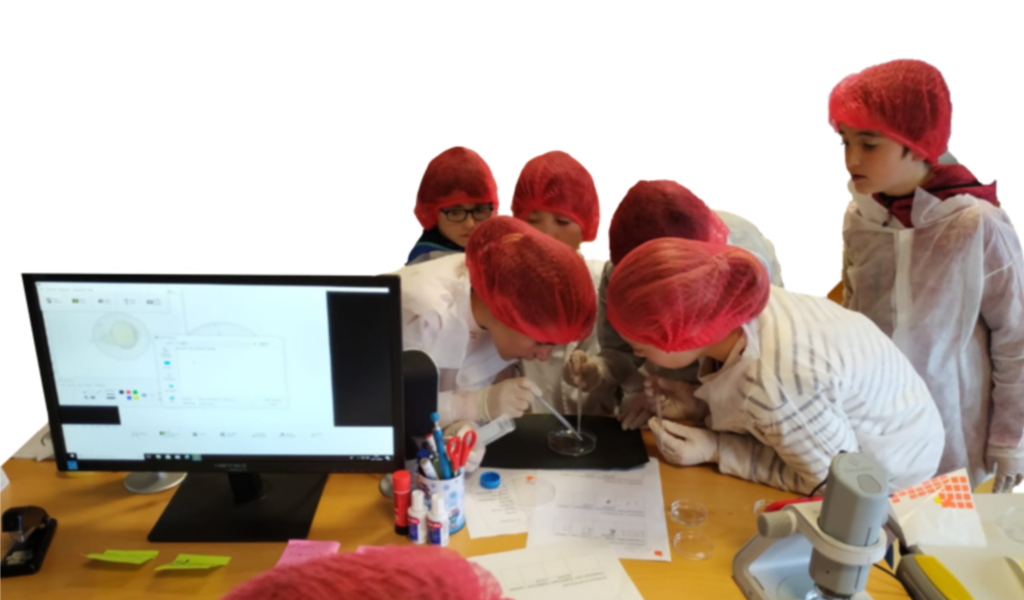
The zebrafish (Danio rerio) is a very popular species in aquariums due to its ease of breeding and it is also an animal that is increasingly used in scientific research. One of the main reasons for its success in science is that it lays transparent eggs that develop very quickly and allow to follow how life evolves inside with a simple microscope.
What Danio eggs look like under the microscope
In Learn Science with Danio, we have developed some science projects for middle and high school based on the zebrafish, in a format very easy to implement for the teacher even if he/she lacks scientific training. They are cross-cutting science projects, encompassing different subjects, in which all the steps of the scientific method are followed.
The excitement that follows the development of these animals, both in students and teachers, makes it one of the best science projects for children, one that will never be forgotten, even if many years go by, and is perfect for awakening scientific vocations in the classroom, especially among girls.
ZEBRAFISH EGGS are also comercially available in the US but to get the most from them we recommend you an assisted program. If you are interesting in our Zebrafish program traslated into English to not hesitate to CONTACT US.
Science projects about invertebrate animals: Artemia salina
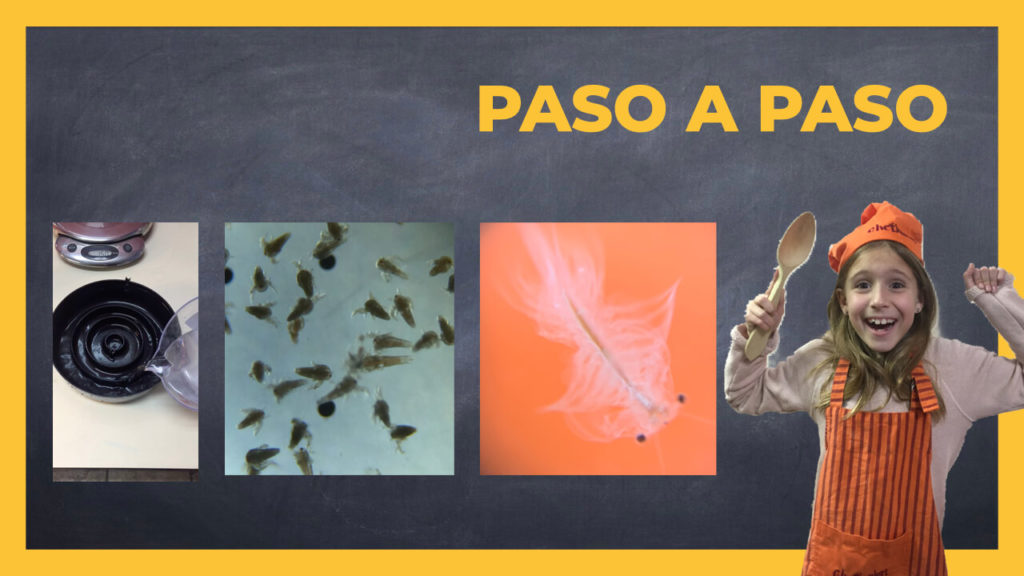
Artemia salina is a small saltwater crustacean, distributed worldwide, widely used for fish and larval feeding in aquaculture and research. It is orange and is responsible for the pinkish color of flamingos. Artemia develop eggs that are resistant to desiccation and can hatch, giving rise to the first stage of their development, the artemia nauplius, which is the most used stage in feeding because it is the most nutritious. If we are doing the Danio project, they are the perfect food.
In this video we explain how to hatch them:
Afterwards, if we feed them with spirulina or Seramicron, we can see how the phase evolves. There are commercial kits as SEA MONKEYS OCEAN ZOO, with food and utensils prepared to breed all phases of artemia.
Adult artemia are also very interesting to observe, and they have sexual dimorphism (we can differentiate males and females). We can even reproduce them and close the circle. In this video, we can see how artemia reproduce:
Science projects about animals based on dissection: the best way to learn how an animal is
As a veterinarian I have to say that probably the way I have learned the most is by dissecting an animal (death, of course), and having a look inside. Of course, with the exception of Danio rerio eggs, which are transparent.
No anatomy slide can replace the experience of seeing the organs and structures directly. Another advantage is that kids can start using surgical equipments, and how knows, maybe in the future the could consider to be a surgeon.
You can find comercially ANIMAL DISSECTION KITS based on different animals, in which you could find really representative characteristics of these animals:
Frog dissection kit:
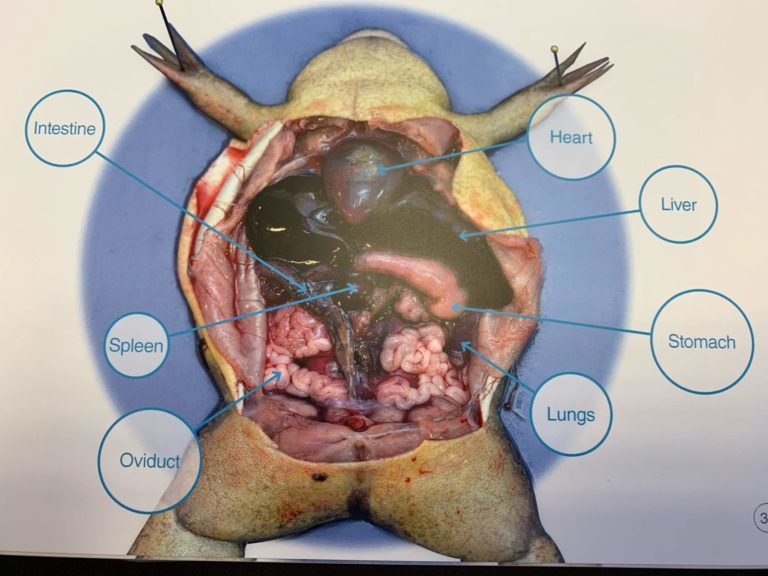
Frogs are amphibians, animals without a diaphragm, with a single coelomic cavity. Another curiosity is that their heart has three chambers: two atria and a single ventricle, which makes them more efficient than fish, which have only two chambers, but less efficient than birds and mammals, which have four chambers. In the picture you can see a dissection of Xenopus laevis and its main organs. (Photography by Tomás García Robles- Juan Ramos Blasco).
Kits can be INDIVIDUAL or in a CLASSROOM PRESENTATION with several specimen.
Fish dissection kit
You can also dissect a cartilaginous fish, a SHARK or a bony fish, a PERCH.
This way you can study differences between both types of fishes. You can even find a MARINE BIOLOGY DISECTION KIT to study other invertebrates as well, as squid, lam and starfish.
Other animal and organ dissection kits
In Home Science Tools you can also find other animals dissection kits or even specific organs as heart, eyes… Perfect to learn about anatomy.
Science projects about animals: insects
Raising silkworms is one of the most classic natural science projects there is, but no less interesting for that. With silkworms we can see all the stages from egg to worm to butterfly. But if you want something more different you can find the BUTTERFLY GARDEN KIT with nicer butterflies.
But the world of insects offers us many opportunities to bring science closer to children. Ángeles Murcia Aniorte, biology teacher at the IES El Palmeral in Orihuela and head of the biological sciences area of the Mudic Museum in Orihuela, can’t resist any «bug»: Drosophila, Mantis, ants, the Samnia Ricini butterfly, stick insects, crickets…. She has filled houses and classrooms with insects, teaming up with her technology classmates to create ant hills, butterfly gardens, microscopes… Did you ever stop to think that you could make a whole Steam project using insects? In this post she tells us about her favorite: stick insects, a project with insects that you can take from kindergarten to high school.
Ángeles is undoubtedly an example of passion for science in the classroom and her experiences are always inspiring.
Science projects about plants
Science projects about plants: onion cells
When working on cells, seeing a real cell helps students to fix concepts. Onions have large cells that are very easy to observe under a microscope in a classic school experiment. They can be stained with methylene blue or lugol and then observed under a normal microscope.
In this video we show you «our version» of observing onion cells, with the DANISOSCOPE, a smartphone microscope, which allows you to observe the cells without staining them.
In high school it will be a great opportunity for teenagers to make a «scientific» use of their smartphones.
Of course you can do it in the «classic» way with a microscope and stain them with a classical gram stain or methylene blue.
Science project about plants: Measure environmental pollution with strawberries!
The Air Watchers project is a citizen science project of the Ibercivis Foundation that aims to develop a map of air quality in Spain using strawberries! The people in charge of the project hand out strawberries to those citizens or schools that want to participate in the project and then analyze them and elaborate a map of air pollution in Spain.
Science projects on microbiology
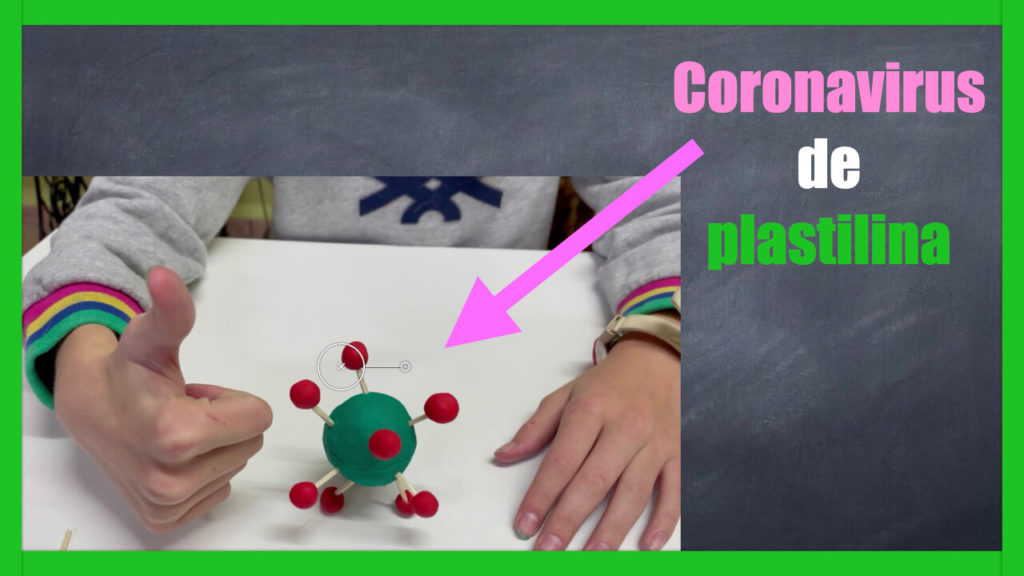
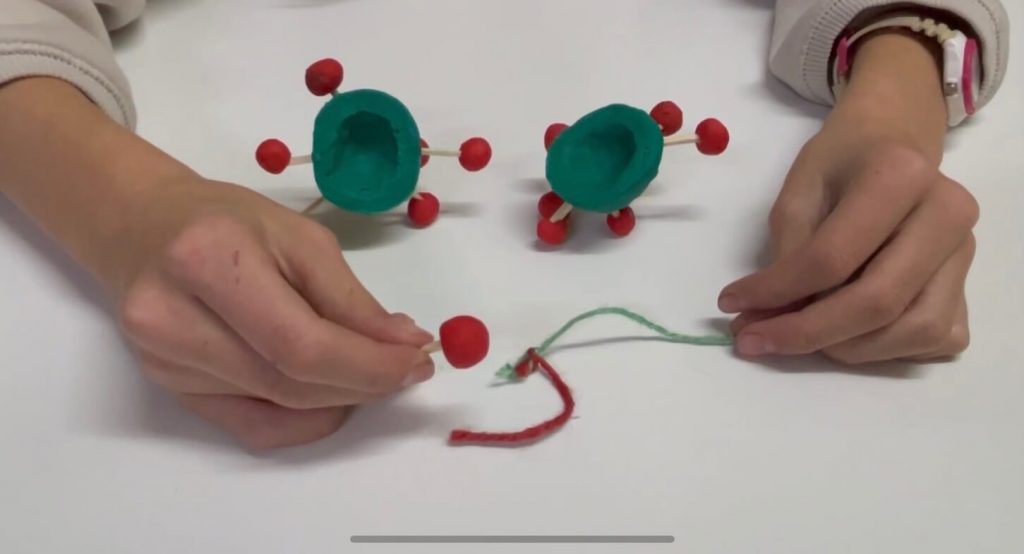
Virus models with plasticine
Representing biological structures with plasticine is a fun way to bring science closer to children so that they can understand how they are and what certain concepts that would otherwise be very abstract are for.
We invite you to watch our youtube video on how to make a coronavirus with plasticine. In it your students will be able to learn while having fun how a virus is enveloped, what are the spicules, those keys with which it enters the cell and how it stores genetic information.
Design your own vaccine
And if you like the idea of making things with plasticine, don’t miss our DESIGN YOUR OWN VACCINE project, a natural science project for primary school students in their last years and also for secondary school, where students will make models of the main vaccines that are currently being talked about with plasticine!
Alcohol and adolescence
Adolescence is a critical time in the acquisition of toxic habits and its prevention is very important. In this high school science project we will address from a scientific point of view that alcohol is a toxic substance. Zebrafish eggs are used in real toxicology tests to evaluate which substances are toxic. Students will see a (virtual) experiment of exposing eggs to different doses of alcohol that will demonstrate that alcohol is a toxic substance and will have to analyze the results as it is done in real research labs. Then the effects of alcohol on the adolescent’s brain are analyzed. This whole project is virtual, no eggs or fish will be harmed in class. More information.
Science projects on genetics
Criminology workshop
I really liked the workshop proposed by Susana Marquez Quintero in her blog BIOCURIOSIDADES on criminology.
Discovering a murderer has a lot of «science» and she proposes to turn our students into detectives who will investigate fingerprints, extract DNA from saliva and delve into those small traits with «dominant» genetic inheritance that will give away our origin without us realizing it.
This blog is beautiful. No wonder they have given it the award for Best Education Blog. My most sincere congratulations.
You can find a CRIME SCENE SCIENCES to do a similar activity.
We are all migrants
Impressive is the proposal of Jose Maria Espinosa Bernal, a high school teacher, who analyzes the mitochondrial DNA of students to trace recent and past migratory routes. He comes to a very simple conclusion: the more or less close ancestors of all of us had to migrate closer or further away, with all the social background that this conclusion implies.
Extract your DNA
Yes , you have DNA as all living creatures in earth. And you can extract it and see it with a DNA EXTRACTION KIT. And you can explain how proteins-RNA and DNA work together with this video: RNA TRANSCRIPTION AND PROTEIN SYNTHESIS
Other ideas to bring science closer to children
There are not only science projects like the ones we have seen. There are more ways to encourage children’s interest in science and motivate them: videos, podcasts, museum visits, even science radio shows for kids. We review our favorites in this science for kids article.
Which topic is best for science project?
The best way to achieve experiential and long-lasting learning is to carry out natural science projects, in which, if possible, concepts from different scientific subjects are mixed and generate excitement.In this article I give you ideas of natural science projects with animals and plants that you can do in the classroom. They can be adapted to both middle and high school and I am sure that neither you nor your students will forget them.
How can I make a science project?
A little patience and a lot of willingness to learn is all you need to bring science into your classroom. In this article we give you ideas for the best science projects that your students will love.
What is science fair project?
A science project is a guided activity you can do with your students in class that will get them working with the scientific method and learning to solve problems on their own.


