
Danio rerio is the scientific name of the zebra fish. They are freshwater fish that originate from the Ganges River region in eastern India. Aquarium lovers love them. If you go to your nearest pet shop you will find them for sure. They are also ideal for your first aquarium because they are so easy to keep. But you know who likes them a lot too: scientists. Yes, yes, you’ve read correctly: scientists all over the world are going crazy breeding zebrafish. And do you know why? Because from this tiny animal we can learn many things about ourselves. Zebra fish is one of the main species used in research worldwide.
Contents
Zebrafish characteristics
Zebrafish belong to the cyprinid or carp family. Adults are between 1-1,5 inches long, but can grow up to 2 inches. They are called that because they have stripes, like zebras. And like them, they prefer to live in groups or cardumens, which is how groups of fish are called. So I don’t recommend that you ever have a zebrafish alone, it would get depressed.
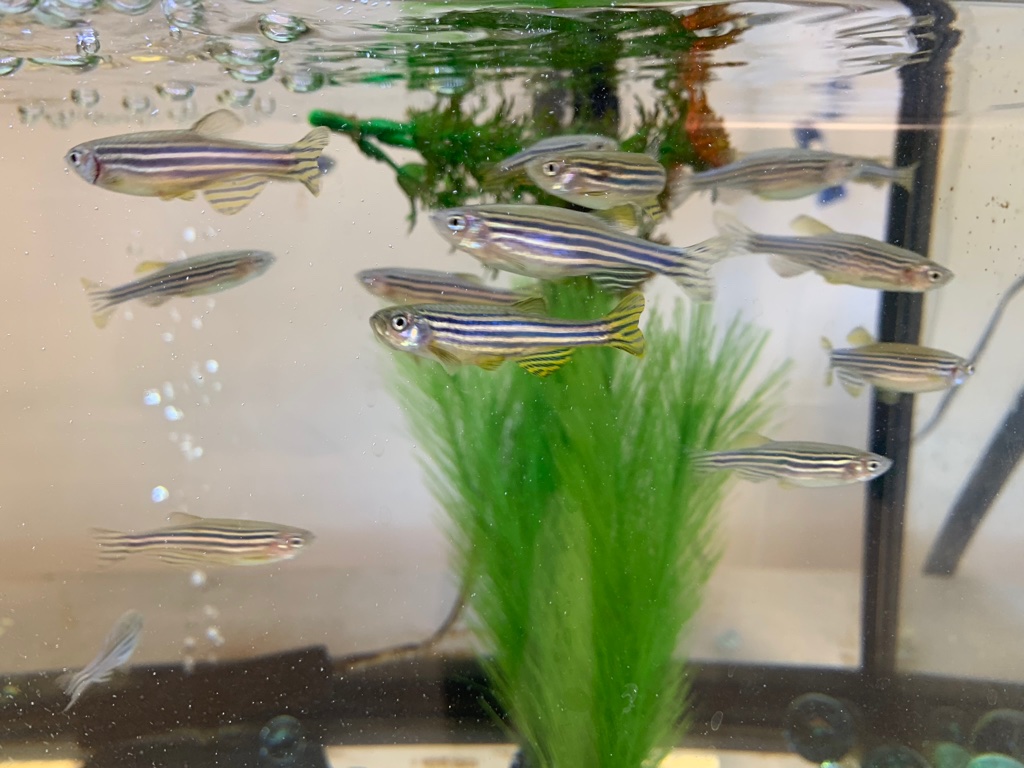
Zebra fish in the wild
In nature, Danio rerio lives in Asia, on the rivers of India, Nepal and Bangladesh. He is not a European or American fish, so if you have zebrafish you should never release them into a European or American river. Zebrafish lives in shallow rivers, and feeds on small bugs he finds there.
How to breed zebra fish
Adult zebrafish are very easy to keep in a conventional aquarium. They are not very demanding in terms of water requirements. In this blog entry, you can check the ideal parameters of the zebrafish aquarium.
Zebrafish reproduction
Danio reproduces in the rainy season, when the Monsoon makes the rivers increase their flow and flood the surroundings. This allows the larvae to find many places to hide in very calm waters, where they take refuge from larger fish that can eat them. They lay their eggs among the vegetation, on the river bank at dawn. They do not take care of the young, but trust that in these more or less sheltered places, some larvae (a low percentage) manage to survive. That is why they lay a lot of eggs: under optimal conditions a female could lay more than 100 eggs. The male extends his flippers and waves his body very close to the female and chases her until she releases her eggs, then the male releases his sperm and the eggs are fertilized in the water.
Male and female Zebrafish
The zebrafish has sexual dimorphism, that means that we can differentiate females and males by the external aspect. In general, males are more stylized and slightly yellowish and females are more plump. Not because they are pregnant, as we have seen fertilization and embryonic development of zebras is external. There cannot be pregant zebrafish as only mammals can be pregnant. Inside that bulky belly they carry the eggs that they will expel (spawn or fry) later. We can distinguish them externally, but despite all that we know about zebrafish, we do not know how sex is determined.
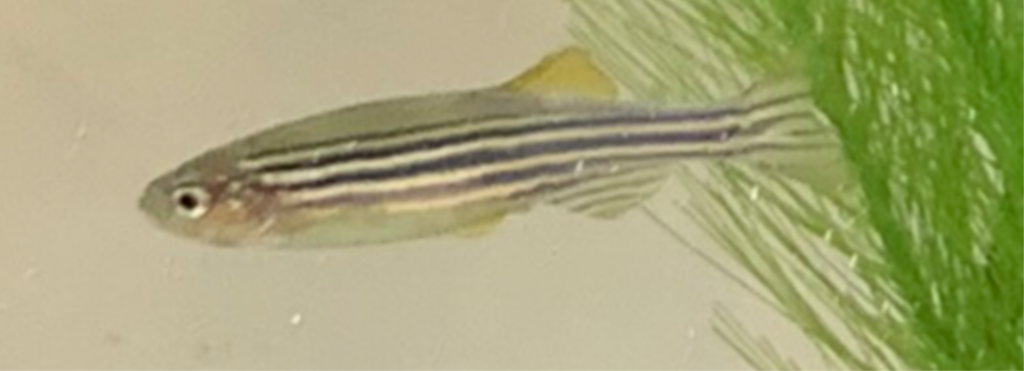
Male zebrafish

Female zebrafish
Zebra fish in research
The zebrafish (Danio rerio) has scientists all over the world enthralled. George Streisinger, a Hungarian molecular biologist who worked at the University of Oregon, is considered responsible for its introduction into science, relatively recently, in the 60s and 70s. He was the first person to clone a vertebrate, precisely our beloved Danio.
Although its initial use was linked to genetics and molecular biology, it is increasingly being used in various disciplines, from developmental biology, immunology and cancer, to toxicology. The advantage of this model is its high fertility, its transparent embryos that allow us to observe its organs in vivo, its small size and the low maintenance costs in the experimental centers. Genetic manipulation is also relatively simple.
You can know more about Danio rerio’s embryonic development in this link.
Zebrafish in teaching
These same characteristics make it a very interesting tool that can be used in education programs. Its transparent embryos allow to follow the development of the embryo from the larva stage to the fish stage live with a simple magnifying glass. The motivational effect of zebrafish on science is extraordinary. For some reason, when you put a child and a zebrafish together, the child automatically falls in love with science.
Learn with Danio is a project that aims to help teachers bring science into their classrooms in an attractive way, through teaching projects that are already prepared and very simple to implement, or by providing materials, such as zebrafish eggs for teachers to use in their classes to develop their own experiences.
The BioEYES project (www.bioeyes.org, Shuda et al) developed in the USA is a zebrafish macro-project involving several collaborating universities and companies. It has a lot of teaching material freely available that can inspire similar experiences.
The project «A zebra in the water», in Spain (www.unacebraenelagua.es Guerra-Varela et al) . It provided the centres with an aquarium kit and access to a computer programme developed for this purpose. This project is not currently active.
Educational resources with zebrafish can also be found at: http://zfin.org/zf_info/news/education.html
Bibliography: to learn more
Zebrafish Overview
- Harper and Lawrence, The Laboratory Zebrafish. Complete book on biology, breeding, veterinary care and basic experimental methodology.
Sex determination
Despite all that is known about zebrafish, it is not very well known how sex is determined.
- Kossack ME1, Draper BW2. Genetic regulation of sex determination and maintenance in zebrafish (Danio rerio). Curr Top Dev Biol. 2019;134:119-149. doi: 10.1016/bs.ctdb.2019.02.004. Epub 2019 Mar 21.
- Hsu CW, Pan YJ, Wang YW, Tong SK, Chung BC. Changes in the morphology and gene expression of developing zebrafish gonads. Gen Comp Endocrinol. 2018 Sep 1;265:154-159. doi: 10.1016/j.ygcen.2018.01.026. Epub 2018 Jan 31. Review.
- Investigación del CSIC Altas temperaturas podrían alterar el sexo de los peces cebra
Zebra fish research
- Why use the zebrafish in reseach? An exhaustive review of the reasons for Danio rerio’s success in scientific research.
- Why use zebrafish to study human diseases?
Frequent asked questions about zebrafish
How do zebrafish reproduce?
Fertilization is external. At dawn the males chase the females and stimulate them with their fins. The females begin to expel eggs and the male fertilizes them with his sperm. You can watch a video of zebrafish spawning on our Youtube channel: https://www.youtube.com/watch?v=pU5LarwbdNM
We are much more alike than we imagine. In fact, we share 70% of our genetic material with fish, which means that we can study 7 out of 10 of our genes in them. In addition, Danio rerio's eggs are transparent and develop very quickly, which allows us to observe how a living being develops live